
For Olim families with young children, one of the most impactful and practically important decisions of early Aliyah is choosing a gan (preschool or kindergarten) for their little ones. The gan is where young immigrant children first encounter Israeli society, begin acquiring Hebrew, and start forming the friendships and social bonds that will anchor their childhood in Israel. It is also where parents make their first sustained contact with Israeli school culture, other families in their neighbourhood, and the rhythms of Israeli daily life. Getting the gan choice right — understanding how the system works, what types of gan are available, how the enrolment process works, and what to expect — makes an enormous difference to the early Aliyah experience for the whole family.
What Is a Gan and How Does It Fit Into Israeli Education?
The word gan (גן) means garden in Hebrew, reflecting the Frobelian philosophy that shaped early childhood education worldwide. In Israeli usage, gan refers to any preschool or kindergarten setting for children from birth through age 6, when primary school (kita aleph, first grade) begins. Israel has invested heavily in early childhood education and was an early signatory to the OECD recommendation on universal preschool from age 3. Israeli law has mandated compulsory free preschool (gan chova) from age 3 since 2010, making Israel one of a small number of countries globally to provide state-funded early childhood education from this age as a legal right.
The gan is more than just childcare — it is considered the first formal educational setting in Israel and is supervised by the Ministry of Education. Ganenot (kindergarten teachers, singular: ganenet) are trained professionals who hold teaching certificates and are responsible for structured learning activities, language development, social skills, and school readiness, as well as play and exploration. The Israeli gan day typically runs from approximately 7:30am to 1:00pm in the base state framework, with afternoon extended care (tzaharon) available until 4–5pm.
Types of Gan Available in Israel
Like the Israeli school system as a whole, the gan system is divided into sectors reflecting Israel’s religious and cultural diversity. Mamlachti (state secular) ganim are the most common type, run by local municipalities and offering a standard early childhood curriculum with Jewish cultural content (holidays, songs, stories) but without religious observance. Mamlachti Dati (state religious) ganim integrate religious Zionist practice and observance — children observe Shabbat customs, the kashrut laws are maintained, and the curriculum reflects a religious Zionist orientation. Haredi (ultra-Orthodox) ganim serve the ultra-Orthodox community with curricula centred on Torah values. Private ganim operate outside the state system and include Waldorf, Montessori, bilingual (Hebrew-English or Hebrew-Arabic), and other alternative approaches. Private ganim charge tuition fees not covered by the state subsidy.
For most Olim families, the choice is between mamlachti and mamlachti dati, depending on religious background. The local municipality will have a map of ganim in your area and their sector affiliation. Visiting prospective ganim before registering — meeting the ganenet and seeing the environment — is strongly recommended, as the quality of the individual ganenet and the warmth of the gan community matter enormously to young children’s experience.
Age Groups and Gan Structure
Israeli ganim are organised by age group. Mishpachton (family daycare, typically 3 months–3 years) is small-group home-based care for the youngest children, typically run by a single childminder (metapelet) in her home with up to 5 children. Maon (daycare centre) provides care for children from approximately 3 months to 3 years in a larger institutional setting. Maon operates under Ministry of Labour supervision and is subject to staffing and safety regulations. Gan Chova (compulsory kindergarten) for ages 3–6 is the core of the Israeli early childhood system. This three-year framework covers the ages of 3, 4, and 5 — with the age-5 year being particularly important for school readiness preparation.
Hebrew Acquisition in the Gan: What to Expect
For parents worried about their young children entering an entirely Hebrew-language environment without any Hebrew, the experience of thousands of Olim families is powerfully reassuring: young children acquire Hebrew in gan with extraordinary speed. Children aged 2–5 who arrive with zero Hebrew are typically communicating in Hebrew within 2–3 months and are fully fluent within 6–12 months. The plasticity of the young brain, the total immersion environment of the gan, the social motivation to communicate with friends, and the warm and structured environment ganenot create all combine to produce remarkably fast language acquisition.
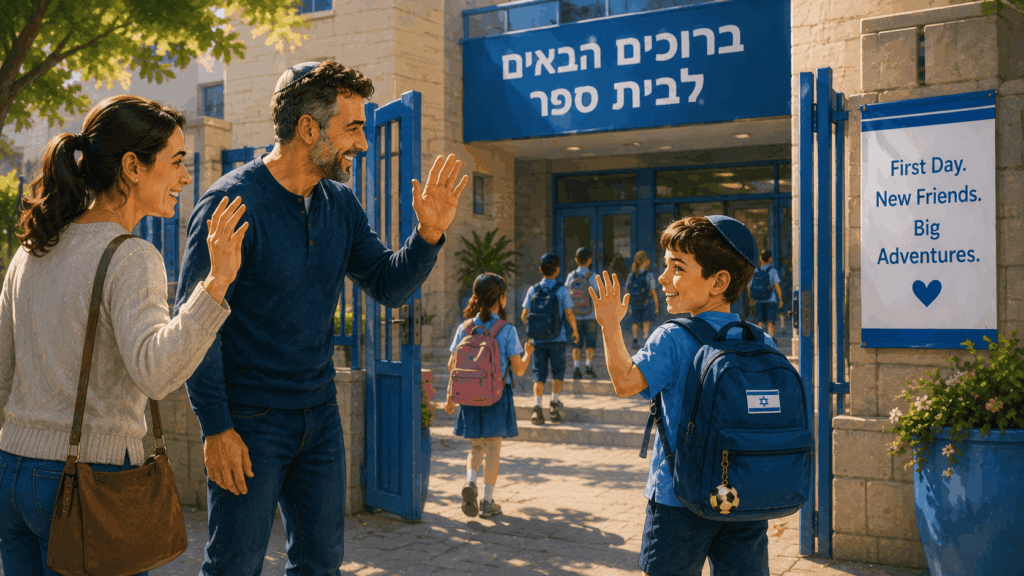
In the short initial period of adjustment, gently prepare your child for the transition: teach them a few Hebrew words (shalom, todah, ma shlomcha), explain that the children and ganenet will speak a different language but that they will learn it quickly, and reassure them that they will make friends. Most ganenot are experienced with Oleh children and will make extra efforts to include and comfort a new child who does not yet speak Hebrew. Request a meeting with the ganenet before your child’s first day to introduce yourself and share any information about your child’s background, personality, and any anxieties they may have.
Enrolment: How to Register Your Child in a Gan
Registration for state-sector ganim in Israel is handled through the local municipality (iriyah). The annual registration period typically opens in January–February for the following September start. However, Olim who arrive mid-year can register their children outside the standard registration window — the municipality is legally required to provide a place for immigrant children. Contact the municipal education department (machleket hachinuch) or the absorption department (machleket haklita) within your first week of Aliyah to initiate enrolment. Bring your child’s Teudat Oleh, birth certificate, and vaccination records (teudat hitchassnut). Vaccination records are required for gan enrolment — children must be up to date with the Israeli vaccination schedule, which is broadly similar to most Western vaccination programmes.
Cost of Gan in Israel: State Subsidies and Parent Fees
State gan chova (ages 3–6) is free under Israeli law. Parents do not pay tuition fees for the core gan programme. However, parents are expected to contribute to the vaad horim (parent committee) fund, which covers enrichment activities, holiday celebrations, class materials, and end-of-year events — typically NIS 500–1,500 per year. The tzaharon (afternoon extended care) programme carries a monthly fee, typically NIS 600–1,000 per month depending on the municipality and the extent of the programme. New Olim may be eligible for reduced tzaharon fees through the municipality’s social services department during the absorption period.
For maon (daycare) for children under 3, the cost structure is different. State-subsidised maon places are available but there are fewer of them relative to demand, and waiting lists are common. Private maon costs NIS 2,000–4,500 per month depending on the area and the quality of the facility. Bituach Leumi (National Insurance) provides a childcare subsidy (mishanot) for lower-income families to offset maon costs — new Olim may be eligible during the absorption period.
At what age does gan start in Israel?
Compulsory free gan (gan chova) begins at age 3 in Israel — one of the youngest mandatory school ages in the world. Children turn 3 by September 1 of the academic year to be eligible. The gan chova programme runs for three years, from ages 3 to 6, after which children begin first grade (kita aleph). Childcare for younger children (from 3 months) is available through private mishpachton (family daycare) and maon (daycare centres), which are subsidised but not free.
Is gan free in Israel for Olim children?
Yes — state gan chova (ages 3–6) is free for all children in Israel, including Olim children, from their first day in the country. Parents contribute to the parent committee (vaad horim) fund for enrichment activities, typically NIS 500–1,500 per year, but this is not a tuition fee. Extended afternoon care (tzaharon) carries a monthly fee. Private and bilingual ganim charge tuition fees and are not part of the free state system. Olim families arriving during the year can register their children mid-year — the municipality is required to provide a state gan place.
Will my child cope in a Hebrew-only gan without knowing Hebrew?
Almost certainly yes — and much more quickly than you might expect. Young children aged 2–5 acquire Hebrew in an immersive gan environment with extraordinary speed. Most Oleh children in this age range are communicating in Hebrew within 2–3 months and are fully fluent within 6–12 months. Ganenot are typically experienced working with immigrant children and will make extra efforts to welcome and include a new child who doesn’t yet speak Hebrew. Teach your child a few key Hebrew words before their first day — shalom, todah, bevakasha — and trust the process.
How do I register my child for gan in Israel?
Contact your local municipality’s education department (machleket hachinuch) or absorption department (machleket haklita) within your first week of Aliyah. Bring your child’s Teudat Oleh, birth certificate, and vaccination records. The municipality will assign a state gan place based on your address and sector preference. New Olim can register outside the standard annual registration period — municipalities are required to provide places for immigrant children throughout the year. In cities with large Anglo communities (Ra’anana, Modi’in, Netanya), the municipal education staff are experienced with Oleh family enrolment.
What is the difference between a maon and a gan chova?
A maon is a daycare centre for children from approximately 3 months to 3 years old, supervised by the Ministry of Labour. It is primarily a childcare provision, operating full day hours (typically 7am–4pm). A gan chova is the compulsory educational kindergarten for ages 3–6, supervised by the Ministry of Education, with a structured learning curriculum and a ganenet (qualified teacher). Gan chova runs a shorter day (approximately 7:30am–1pm), with an optional extended care afternoon (tzaharon). The maon is not free; gan chova is free. Both are available in secular and religious sector versions.
Can my child join a gan mid-year after Aliyah?
Yes. Israeli municipalities are legally required to provide state school and gan places for newly arrived immigrant children at any point in the school year. There is no need to wait for the September intake. Contact the municipal education department immediately after Aliyah and your child can typically begin gan within 1–2 weeks of registration. Mid-year joiners integrate well — the gan environment is continuous and children adapt to new classmates readily. The ganenet will be prepared for your child’s arrival and the transition is usually smoother than parents anticipate.