
Israeli Schools for Olim Children: A Complete Guide for New Immigrant Families
One of the first and most urgent concerns for families making Aliyah is their children’s education. How will the kids manage in a Hebrew-speaking classroom? Which school sector is right for our family? What support will be provided for new immigrant children? How does the Israeli school system compare to what we had at home? These are questions every Oleh family faces, and the answers are more reassuring than many parents expect. Israel has a well-developed system for absorbing immigrant children, and most children adapt with remarkable speed. This guide walks you through every aspect of Israeli schooling for new Olim families.
Overview of the Israeli School System
Israeli schooling is compulsory from age three (gan chova, the mandatory kindergarten year) through to age eighteen. The system is divided into several distinct sectors, each with its own curriculum, religious character, and administrative oversight. Understanding these sectors is essential for Oleh families, as your choice of school sector will shape your children’s entire educational experience in Israel.
The school year in Israel runs from September (approximately the first of September) through to late June, following the Hebrew calendar with breaks for all major Jewish holidays: Rosh Hashana, Yom Kippur, Sukkot, Chanukah, Purim, Pesach, and Shavuot. The academic year is divided into two semesters, with a summer holiday of approximately six to seven weeks. For families arriving mid-year from the Northern Hemisphere’s academic calendar (which typically runs September to July), the timing is usually well aligned.
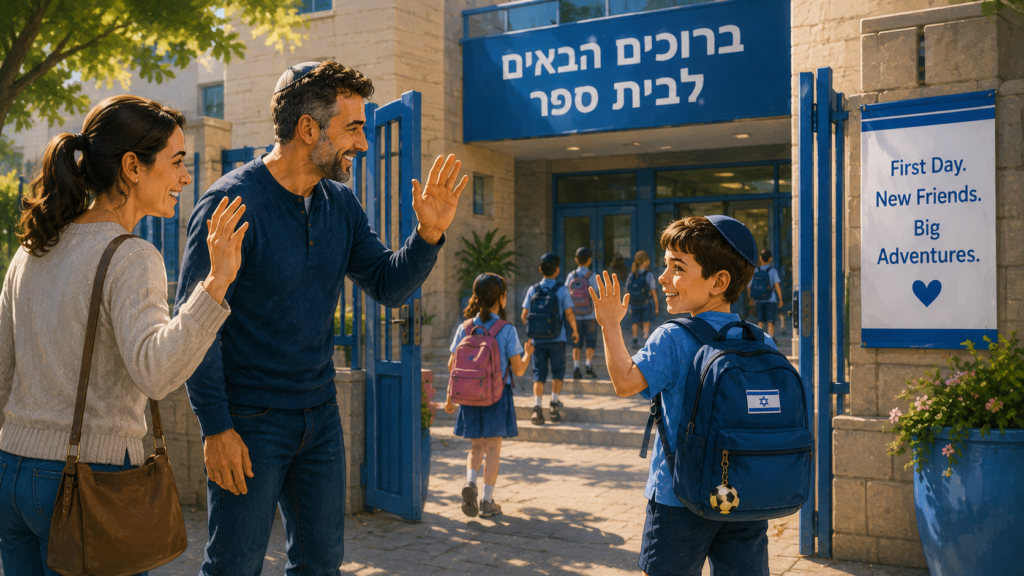
The Four School Sectors
Israel’s public school system operates across four main sectors, each funded by the state but with different religious and cultural orientations.
State (Mamlakhti — ממלכתי): The secular state school system, which accounts for the largest share of Israeli students. Instruction is in Hebrew, the curriculum follows Ministry of Education standards, and there is minimal religious content beyond Jewish history and culture taught as academic subjects. Ideal for secular or traditional families from a variety of backgrounds.
State-Religious (Mamlakhti Dati — ממלכתי דתי): A state-funded religious Zionist school system that integrates Torah study, religious observance (Shabbat, kashrut, prayer), and a strong Zionist identity alongside the standard academic curriculum. Schools are gender-separated at secondary level. Suitable for modern Orthodox and religious Zionist families.
Haredi (Ultra-Orthodox): Schools within the Haredi sector follow their own curricula, which emphasise Torah and Talmud study and have varying degrees of secular academic content. Haredi schools are generally gender-separated from an early age. Government funding is provided but the schools operate with significant autonomy. Primarily serves families within the Haredi community.
Arab (Israeli Arab sector): Arabic-language state schools serving the Israeli Arab population. Not relevant for most Jewish Olim but important context for understanding the full system.
Beyond these four main sectors, there are also independent schools, including some English-language or bilingual schools in cities with large Anglophone communities, Waldorf and Montessori schools, and democratic (free-school) schools. These are fee-paying private institutions and are not part of the free state system.
School Levels and Age Ranges
| Level | Hebrew Name | Ages | Grades |
|---|---|---|---|
| Nursery (optional) | Gan Yeladim | 0–3 | — |
| Preschool (optional) | Gan Tipot / Kitot Yod | 3–4 | — |
| Mandatory Kindergarten | Gan Chova | 4–5 (age 3 from 2022) | — |
| Pre-1st grade | Kitah Aleph Makon / Kitah Aleph | 5–6 | — |
| Primary School | Beit Sefer Yesodi | 6–12 | 1–6 |
| Middle School | Beit Sefer Beynoni / Chativat Benayim | 12–15 | 7–9 |
| High School | Tichon | 15–18 | 10–12 |
Education is free and compulsory from kindergarten through grade 12. University is a separate fee-based system for which students apply after completing their Bagrut (matriculation exams).
The Bagrut: Israel’s Matriculation Examination
The Bagrut (בגרות) is Israel’s national matriculation certificate, taken during grades 10–12. Students accumulate units (yechidot limud) across required and elective subjects — Hebrew language, mathematics, English, history, and Bible study are core requirements. Students choose additional electives and specialisations. The Bagrut is graded on a 100-point scale and weighted by difficulty level (the number of units attempted in each subject). A full Bagrut — the minimum required for university entry — requires at least 21 units across mandatory and elective subjects.
For Olim children who arrive in high school, the Ministry of Education provides special Bagrut accommodations: extended time on exams, the right to sit certain exams in their native language for several years, and exemptions or substitutions for certain Hebrew-intensive subjects during the absorption period. These accommodations are critical — speak to the school’s absorption coordinator (rakezet klita) to ensure your child is registered for all applicable accommodations.
Hebrew Language Support: Ulpan Kalpit
Every Israeli school is required to provide Hebrew language support for newly arrived immigrant children. This support programme is called Ulpan Kalpit (אולפן כלפית) at the primary level and similar intensive programmes at middle and high school level. Ulpan Kalpit classes typically run daily, pulling immigrant children out of certain mainstream lessons to provide intensive Hebrew instruction. The goal is to bring children to a level where they can follow mainstream classroom instruction as quickly as possible.
The intensity and quality of Ulpan Kalpit varies significantly between schools and municipalities. Schools in cities with large Oleh populations — Netanya, Ra’anana, Haifa, Jerusalem, Modi’in — tend to have well-resourced and experienced immigrant support programmes. In towns with few immigrant children, support may be more limited. When researching schools, ask specifically about the Ulpan Kalpit programme: how many hours per week, how many immigrant children are currently in the programme, and what the average time to full mainstream integration has been for recent Olim children.
Children’s Hebrew acquisition is generally remarkably fast. Most children aged 8–12 achieve conversational fluency within six to twelve months of immersion. Younger children (under 8) often absorb Hebrew within three to six months. Teenagers face the biggest challenge, as they have more established cognitive patterns and also face the social pressure of peer group integration at a sensitive age — dedicated support for Olim teenagers is particularly important.
How to Enrol Your Child in an Israeli School
School enrolment for Olim is handled through the local municipality (iriyah) or regional council (moatza). On arrival, contact your local absorption department (machleket haklita) and they will direct you to the municipal education department (machleket hachinuch). Bring your children’s birth certificates, Teudat Oleh, and any school records or transcripts from your previous country. Schools may request a translation of foreign transcripts, though this is not always mandatory for initial enrolment.
Grade placement in Israel is age-based: children are placed in the grade corresponding to their age, regardless of what grade they attended in their previous country. If there is a discrepancy — for example, if your child was a year ahead in the previous system — you can discuss grade skipping with the school, but it requires approval and assessment. In practice, most families find age-appropriate placement works well, as the Hebrew language gap means children benefit from being with peers of the same age even if academically they could be in a higher grade.
English-Language and International Schools in Israel
Several fee-paying schools in Israel offer English-language or bilingual education, catering specifically to Anglophone Olim and international families. Notable examples include the Jerusalem American International School, the Walworth Barbour American International School in Even Yehuda (near Netanya), and various schools affiliated with the Anglo community in Ra’anana and Herzliya. These schools follow international curricula (IB, American AP, or British IGCSE) alongside Israeli requirements. They are significantly more expensive than state schools but provide a gentler transition for children who arrive with no Hebrew and need to maintain academic progression in English while developing Hebrew.
Some Oleh families start their children in an international school for one to two years and then transition to the Hebrew state system once the language barrier has been substantially overcome. This can be an effective strategy, though it means the children spend less time in the immersive Hebrew environment that produces the fastest language acquisition.

Extracurricular Activities and Social Integration
Social integration is as important as academic integration for Olim children. Youth movements (tnuot noar) are a central feature of Israeli childhood and adolescence — Bnei Akiva (religious Zionist), Tzofim (Israel Scouts), HaShomer HaTzair, and others provide structured weekly activities, camps, and social frameworks that cut across school boundaries. Joining a youth movement as early as possible is one of the best ways for Olim children to build Hebrew-speaking friendships outside the school environment.
After-school programmes (tzaharon) run in most Israeli schools from the end of the school day until 4–5pm, providing structured supervision, homework help, and enrichment activities. Enrolment is subsidised for low-income families and available to Olim families at standard rates. The tzaharon is an excellent immersive Hebrew environment for younger children.
Is Israeli schooling free for Olim children?
Yes. State school education is free for all children in Israel from kindergarten (gan chova) through grade 12. This includes Olim children from their first day in Israel. There may be modest fees for certain extracurricular activities, school trips, and supplementary materials, but core education is fully funded by the state. Private and international schools charge tuition fees and are not part of the free state system.
How quickly do children learn Hebrew in Israeli schools?
Children’s Hebrew acquisition in an immersive school environment is remarkably rapid. Children under 8 typically achieve conversational fluency within three to six months. Children aged 8–12 generally reach functional fluency within six to twelve months. Teenagers take longer — typically one to two years to reach the level needed for academic success across all subjects — and benefit most from intensive targeted support. The school’s Ulpan Kalpit programme and the child’s overall Hebrew immersion outside school hours (in youth movements, with neighbours, watching Israeli TV) are the key determinants of speed.
Which school sector should Olim families choose?
The right choice depends on your family’s religious identity and values. Secular and traditional families generally enrol in the state (Mamlakhti) system. Modern Orthodox and Religious Zionist families typically choose the state-religious (Mamlakhti Dati) system. Haredi families use Haredi schools. All state sectors provide free education with Hebrew immersion and immigrant support. It is also worth visiting specific schools in your neighbourhood — the quality of the individual school and its immigrant support programme often matters more than the sector label.
What is the Bagrut and how does it affect Olim teenagers?
The Bagrut is Israel’s national matriculation certificate, taken in grades 10–12 and required for university admission. Olim teenagers receive special accommodations including extended exam time, the right to sit certain exams in their native language for several years after Aliyah, and exemptions or substitutions for certain Hebrew-language-intensive requirements during the absorption period. These accommodations are officially mandated — ensure your child’s school registers them for all applicable accommodations immediately on enrolment.
What documents are needed to enrol a child in an Israeli school?
Required documents typically include your child’s birth certificate, Teudat Oleh, proof of Israeli address, and school records or transcripts from the previous country. Schools may also request vaccination records (teudat hitchassnut). Contact your local municipal education department (machleket hachinuch) for the specific list in your city. In most cases, Olim children can begin school very quickly after arrival — the municipality prioritises prompt enrolment for immigrant children.
Are there any English-language schools in Israel?
Yes. Several fee-paying international and bilingual schools offer English-language education in Israel, including the Walworth Barbour American International School (near Netanya), the Jerusalem American International School, and various community schools in Ra’anana and Herzliya catering to the Anglo community. These follow international curricula (IB, AP, or IGCSE) and are more expensive than state schools. They are suitable for families who need to maintain academic continuity in English during the transition period, or for families planning to return abroad after a few years. Long-term, most Oleh families transition their children into the Hebrew state system.